Kitchen Exhaust Cleaning in Pickering
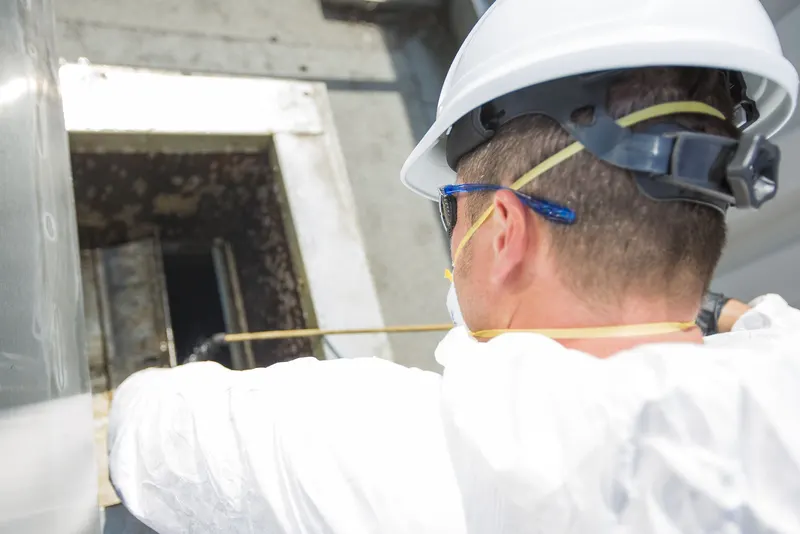
Kitchen Exhaust Cleaning in Pickering is the degreasing of the ductwork that carries cooking vapour from the hood collar to the rooftop fan: the horizontal run above the ceiling, the riser, and the access panels that let a crew reach each section. Pickering Hood Cleaning opens every panel on the run, brings each section back to bare metal, checks the NFPA 96 grease limit of 0.078 inches along the whole path, and lists every section by name on a signed certificate referencing the published standard. Shared risers in Kingston Road and Bayly Street plazas are documented tenant by tenant.
Horizontal run, riser and access panels: where the grease goes after the hood
The horizontal run starts at the duct collar and travels above the kitchen ceiling toward the shaft. Grease cools as it moves, settles on the floor of the duct, and slams into the far wall of every elbow. Two elbows can hold half the deposit on a run.
The riser is the vertical leg up to the fan. Grease condenses on its walls, slides back down and pools at the bottom of the turn. A look down from the roof shows clean metal near the top and says nothing about the base.
Access panels are gasketed openings in the duct wall so each section can be reached, cleaned and photographed. Without them a crew gets an arm and a brush into the collar and no further. The canopy, filters and plenum are on the hood cleaning services page, and the fan on the exhaust fan repair page.
Hood-only cleaning vs full-system cleaning in Pickering
Both scopes leave a shiny canopy. Only one answers the questions an inspector or insurance adjuster brings into the kitchen.
| The question that gets asked | Hood-only vs full-system: what hood-only says | What full-system says |
|---|---|---|
| Did anyone open the horizontal run? | No. The collar got a wipe from underneath. | Yes, at every panel, with a dated photograph through each. |
| How many access panels are on this run? | No idea. | Counted on the walk-through, with any missing panel quoted and fitted. |
| Where was 0.078 inches measured? | At the hood and nowhere else. | Collar, each elbow, riser base and fan inlet, each reading written down. |
| What does the certificate list? | One word: hood. | Every section cleaned by name, and every section not reached with the reason. |
| Does this record satisfy the published interval? | No. NFPA 96 sets its intervals for the system, not the canopy. | Yes, for the cooking volume the kitchen runs. |
The published inspection intervals are on the NFPA 96 page.
Kitchen exhaust cleaning services for Kingston Road and Bayly Street plazas with a shared riser
Pickering Hood Cleaning records each tenant branch to the junction and quotes the riser itself to the landlord who owns it.
Pickering and Ajax are plaza towns. The strips along Kingston Road from Whites Road to Harwood Avenue, the plazas on Bayly Street, and the older blocks on Brock Road and Westney Road were mostly built with three or four food units tied into one riser. Each unit holds its own hood certificate while the shaft above loads from every line and nobody is responsible for it.
The split gets written down before the truck arrives. Each unit owns its canopy, plenum and branch duct as far as the junction. The riser and the rooftop fan belong to the building. The tenant certificate states where the branch stops, and the riser quote goes to the property manager with proof of WSIB coverage and liability insurance sent to both. A landlord who declines the riser work is noted on the tenant record.
Landlord roof access. The riser is cleaned from the top as well as the bottom, so the roof hatch has to be unlocked. Most plaza managers in Pickering and Ajax want a certificate of insurance on file before handing over a roof key, and the walk-through requests it early.
Where the 0.078 inch measurement is taken along a Pickering duct run
NFPA 96 sets the acceptable grease depth at 0.078 inches on every surface the exhaust stream touches, so the depth is read where deposit builds.
Four readings go on every full-system certificate: the collar, where the stream first slows; the outer wall of each elbow, where grease is flung; the base of the riser, where everything drains; and the fan inlet, the last surface before discharge and the one most often left off a record. A reading at the canopy face predicts none of the four.
A section with no panel is not measured and not certified. It goes on the record as inaccessible, with the panel needed to fix it.
Top-rated kitchen exhaust cleaning in Pickering: what to look for
Kitchen exhaust cleaning services in Pickering should be judged on whether the contractor can show the inside of the duct.
Photographs from inside the run. Before and after, through every panel, with a date on each one.
A panel count on the quote. A contractor who has walked the run knows how many panels it has and how many it is missing.
A certificate that names sections. Collar, run, elbows, riser, fan inlet, each on its own line, with anything unreached listed separately.
A plan for the shared riser. Ask who is being quoted for the shaft. When the answer is nobody, the shaft stays dirty.
Coverage by community is on the areas served page, and Ajax kitchens have their own page at hood cleaning in Ajax.
How much does kitchen exhaust cleaning cost in Pickering in 2026?
Pickering Hood Cleaning charges from $385 per visit for a single-hood kitchen up to ten feet and from $725 per visit for a multi-hood kitchen of two to four canopies, with shared-riser and larger systems quoted on site after a free walk-through. The written quote comes back within 24 hours.
On a full-system job the duct decides the hours. Run length, elbow count, riser height and how many usable panels exist all move the figure, and any panel that has to be fitted is its own line on the quote.
Next step: call 289-278-7261 or request a written quote. Say whether the unit shares a wall with another kitchen. Every other service is on the services page.
Kitchen exhaust cleaning in Pickering: frequently asked questions
Who pays to clean the shared riser in a Pickering plaza?
The building, under almost every commercial lease in Pickering and Ajax. The riser and the fan are common elements owned by the landlord; each tenant is responsible for its own hood and branch duct. Pickering Hood Cleaning quotes the two separately.
How many access panels should a duct run have?
Enough to reach every section. NFPA 96 expects the system to be accessible along its full length: a panel near the collar, one at each change of direction, and one at the base of the riser. Most runs in Pickering that have never been opened have one panel or none.
Does cutting a new access panel weaken the duct?
No. A compliant panel is a framed, gasketed door that seals under fan suction and opens on every future visit. The section that never gets a panel is the real weak point.
Can the duct be cleaned without tearing up the dining room ceiling?
Almost always. The run sits above the kitchen ceiling and the panels are reached from the kitchen side. Where a run crosses above a dining room, as in some older buildings in Pickering Village, the tiles are lifted and put back on the same overnight visit.
Is the 0.078 inch limit the same on the duct as it is on the hood?
Yes. NFPA 96 makes no allowance for sections that are awkward to reach. The depth that fails a plenum fails an elbow or a riser base, where deposit is thickest. The limit and the intervals are on the NFPA 96 page.